
On this page
Key takeaways
- The four Usui Reiki symbols are Cho Ku Rei, Sei He Ki, Hon Sha Ze Sho Nen and Dai Ko Myo.
- The first three are usually taught at second level and Dai Ko Myo at master level, each after an attunement.
- There is no scientific evidence that Reiki energy exists; Reiki is complementary and never replaces medical care.
- Clients don't need to know the symbols; some lineages ask students to keep them private out of respect.
Reiki symbols are a small set of shapes and sacred words that Usui Reiki practitioners use to focus intention during a session. The four best known are Cho Ku Rei, Sei He Ki, Hon Sha Ze Sho Nen and Dai Ko Myo. The first three usually come at second level and Dai Ko Myo at master level.
I'm Michelle Virtue, a psychic medium and certified Reiki Master Practitioner, and these symbols are part of my own healing practice. This guide explains their names, their traditional meanings and how they are used, along with how they are passed on and why some lineages prefer to keep them private. If you're new to Reiki itself, my guide to what Reiki is and where it came from is a good place to start.
What Reiki symbols are, and what they are not
Within the Reiki tradition, each symbol is understood as a key or focus that helps the practitioner direct healing energy in a particular way. They are drawn, usually with the hand or visualised in the mind, and the symbol's name is often repeated silently three times. Many practitioners describe them as tools for concentration and intention rather than as having power in themselves.
It helps to be clear about a few things they are not. They are not magic spells, and they don't work on someone without their consent. They are also not proof of anything in a scientific sense. Research has not shown that Reiki energy exists or that symbols change any physical process, and a 2015 Cochrane review judged the trials on anxiety and depression too few and too small to draw conclusions. People do often report feeling relaxed and supported during Reiki, and that is the spirit in which I offer it: as a complementary practice that sits alongside, and never replaces, medical care.
The history is also more tangled than many books suggest. Accounts differ on how Mikao Usui, who developed Reiki in Japan in the early twentieth century, used symbols in his own teaching. One widely repeated account is that he introduced them later to help students who found it harder to sense energy. Different branches have developed their own versions since, so you will find slightly different shapes and spellings depending on where you look.
The four Usui Reiki symbols and their meanings
These are the symbols most commonly published in Western Reiki books and courses. Names, translations and uses vary a little between teachers, so treat this as a general guide.
| Symbol | Common name | Traditional use | Usually taught at |
|---|---|---|---|
| Cho Ku Rei | The power symbol | Increasing or focusing energy; also used to open and seal a session or a space | Second level |
| Sei He Ki | The mental and emotional symbol | Harmony, emotional balance and working with habits and stress | Second level |
| Hon Sha Ze Sho Nen | The distance symbol | Sending Reiki across distance or time, and working with past events | Second level |
| Dai Ko Myo | The master symbol | Deep spiritual healing and giving attunements | Master level |
Cho Ku Rei, the power symbol
Cho Ku Rei is often the first symbol a student learns. Its name is usually translated along the lines of "place the power here" or "put all the power of the universe here". Practitioners use it to strengthen the flow of Reiki at the start of a session, over a particular area of the body, or to close a treatment. Some also draw it over a room, a meal or an object as a simple blessing.
Sei He Ki, the mental and emotional symbol
Sei He Ki is associated with harmony between mind and heart. It is commonly used when someone is carrying anxiety, grief or emotional overwhelm, or wants support in changing a habit. Practitioners usually combine it with Cho Ku Rei.
Hon Sha Ze Sho Nen, the distance symbol
Hon Sha Ze Sho Nen is built from Japanese characters, and it is often loosely interpreted as "no past, no present, no future". Within Reiki it is used for distance healing and for working with situations that sit in the past or ahead in time. It is the symbol that most stretches belief for newcomers, and there is no scientific explanation for how distance healing could work. Its meaning within the practice is about connection, a reminder that care and intention are not limited by space.
Dai Ko Myo, the master symbol
Dai Ko Myo is usually translated as "great shining light" or "great enlightenment". It is taught at master level and is used for the deepest healing work and in the attunement process. Many Reiki Masters see it as a symbol of the soul's connection with the divine, and they treat it with particular reverence.
How Reiki symbols are taught at each level
Reiki training is traditionally organised in levels, and the symbols are introduced gradually rather than all at once.
- First level: students learn hands-on self-healing and how to give Reiki to others. In most lineages, no symbols are taught yet.
- Second level: students receive the first three symbols, learn to draw them and their names, and practise using them in sessions, including distance work.
- Master level: students receive Dai Ko Myo and, if they train as teachers, learn how to pass on attunements. Some lineages split this into a Master Practitioner stage and a separate Master Teacher stage.
Some Western lineages add further, non-Usui symbols at master level, such as Raku or a Tibetan version of Dai Ko Myo. These are later additions, and not every Usui teacher uses them. The names and structure of Reiki levels can vary from one teacher to the next, so it's always worth asking exactly what a course includes before you sign up.
What a Reiki attunement involves
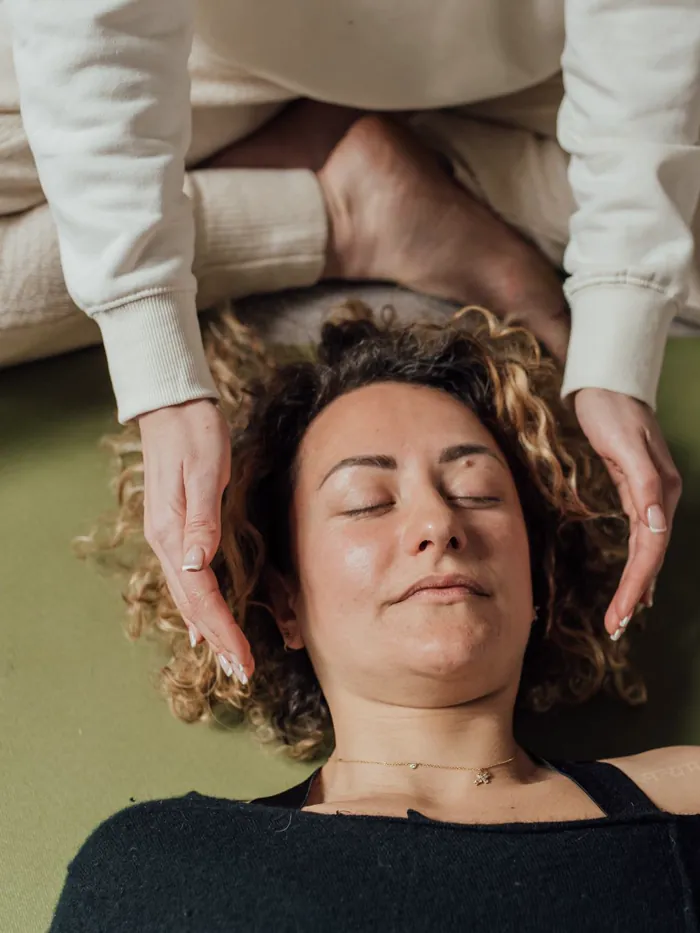
A Reiki attunement is a short ritual a Reiki Master performs for a student at each level. Within the tradition, it is understood to open or strengthen the student's ability to channel Reiki, and at second and master levels to connect them with the symbols they are receiving. The student usually sits with their eyes closed while the teacher moves around them, drawing symbols in the air and sometimes touching the head, shoulders or hands.
People describe very different experiences: warmth, tingling, emotion, colours, a deep calm, or nothing much at all. None of these is a measure of whether it has "worked". Afterwards, many teachers recommend a period of gentle self-treatment, rest and plenty of water while things settle.
Attunements are part of being trained, not something a client needs. If you simply want to receive Reiki, you don't need an attunement and you don't need to learn any symbols.
Respecting lineages that keep symbols private
For many years, the symbols were treated as sacred and secret. Hawayo Takata, the teacher usually credited with bringing Reiki to the West, is widely reported to have asked students not to write them down or show them to anyone uninitiated. In recent decades the symbols have been printed in many books and online, and many teachers now feel they are best understood openly.
Both views deserve respect. Some lineages still ask students to keep them private, out of reverence and to protect the relationship between teacher and student. Others argue that a symbol carries no power without training, so publishing it does no harm. I've chosen not to draw or describe the strokes here. If you'd like to learn them, a good teacher will show you in person, explain their lineage and give you time to practise.
A practical point if you're looking for a course: be cautious of anyone offering instant "attunements" online for a few pounds with no teaching, support or practice. The symbols are a small part of Reiki. Steady self-practice, ethical training and supervised experience matter far more.
Using Reiki symbols in practice, and where to go next
For trained practitioners, using the symbols becomes second nature. In my own sessions, I bring them in quietly as I work, often without the client noticing anything other than a sense of calm. Symbols are not something a client has to know about, see or believe in.
Some practitioners also use them in daily life: drawing Cho Ku Rei over themselves in the morning, using Sei He Ki before a difficult conversation, or sending distance Reiki to someone who has asked for it. The common thread is intention and consent. If you're building a daily self-practice, pairing it with a short beginner's meditation helps settle the mind first.
If you'd like to feel what a session is like, here is how my energy healing in London works. You might also find my guide to spiritual healing helpful if you're comparing approaches. Whatever you choose, remember that Reiki is complementary. It is not a substitute for medical, psychological, legal or financial advice, so carry on with any treatment and appointments your doctors have recommended.
Sources
- Reiki: What You Need To Know, US National Center for Complementary and Integrative Health (NIH). Accessed 4 November 2026.
- Reiki for the treatment of anxiety and depression (Joyce and Herbison, 2015), Cochrane. Accessed 4 November 2026.
- Reiki for depression and anxiety (Cochrane Database of Systematic Reviews, 2015), PubMed (NLM). Accessed 4 November 2026.
- Reiki, Cancer Research UK. Accessed 4 November 2026.
- Reiki, Complementary and Natural Healthcare Council. Accessed 4 November 2026.
- UK Reiki Federation, UK Reiki Federation. Accessed 4 November 2026.
- The Reiki Council, The Reiki Council. Accessed 4 November 2026.
Spiritual traditions are described as traditions, and research is linked where it exists. Guidance here is not a substitute for medical, psychological, legal or financial advice. How these guides are written and checked.
- Grounding Techniques and Spiritual Protection for EmpathsPractical, fear-free grounding techniques, simple spiritual protection and energy cleansing for empaths, sensitive people and anyone developing their intuition.
- What Are Chakras? The Seven Chakras and Chakra HealingChakras are energy centres described in Indian yogic and tantric traditions. Here is where the idea began, how the seven-chakra system took shape, and how people work with chakras today.
- What Is an Aura? Aura Colours and the Etheric BodyAn aura is the field of energy many spiritual traditions believe surrounds every living being. Here is where the idea comes from, what the colours and layers are said to mean, and how to explore it.