

On this page
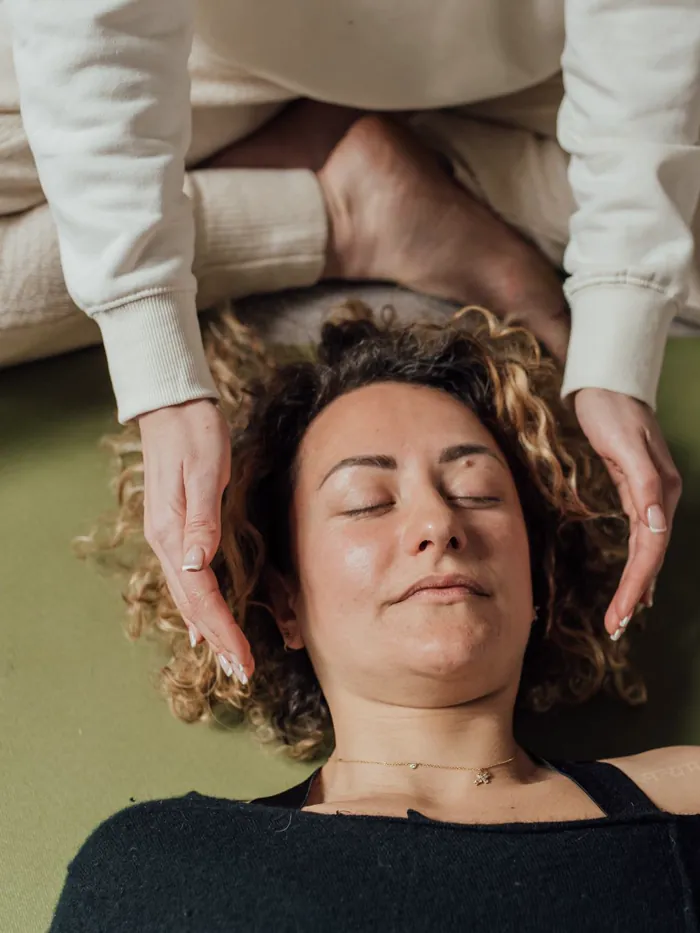
Reiki is a Japanese complementary practice in which a practitioner places their hands lightly on or just above your body, with the intention of supporting deep relaxation and a sense of balance. Practitioners describe it as channelling "universal life energy", the rough meaning of the Japanese word reiki, although there is no scientific evidence that such an energy exists.
I'm Michelle Virtue, a certified Reiki Master Practitioner, and I offer energy healing to clients in London alongside my work as a psychic medium. Reiki is one of the most searched-for complementary therapies in the UK, so this guide covers where it came from, what actually happens in a session, how the training levels work, and an honest summary of the research.
The most important point comes first. Reiki is complementary: it can sit alongside medical care, but it doesn't replace it, and it's never a reason to delay seeing a doctor.
What is Reiki and where does it come from?
Reiki as practised today traces back to Mikao Usui, a Japanese spiritual practitioner who developed the system in Japan in the early 1920s. The traditional account says Usui experienced a profound realisation after a period of fasting and meditation on Mount Kurama, north of Kyoto, and went on to teach a method known as Usui Reiki Ryoho, founding a society in Tokyo.
Among his students was Chujiro Hayashi, a former naval officer, who developed a more structured, clinic-based approach. Hayashi trained Hawayo Takata, a Japanese American woman from Hawaii, who brought Reiki to the United States in the late 1930s. From there it spread to Europe, including the UK, gathering pace from the 1980s onwards.
Many branches have formed along the way, so practitioners now use slightly different hand positions, symbols and teaching styles. The shared core is gentle, non-invasive touch offered with a calm, focused intention.
What happens in a Reiki session
A typical Reiki session lasts somewhere between 45 minutes and an hour and a half, and you stay fully clothed throughout. Here's what you can usually expect.
- A short conversation. The practitioner asks how you're feeling, about any health conditions, and if you're comfortable with light touch.
- Settling. You lie on a treatment couch, or sit in a chair if that's easier, often with a blanket over you. Soft music or quiet is common.
- The treatment. The practitioner places their hands lightly on, or slightly above, a sequence of positions such as the head, shoulders, torso, knees and feet, resting at each for a few minutes. There's no massage or manipulation.
- Closing. You're given time to come round slowly, usually with a glass of water and space to talk about how it felt.
People describe a range of sensations: warmth, tingling, heaviness, emotional release, or simply deep calm. Some feel very little, and that's normal too. A good practitioner won't tell you what you ought to have felt.
In my own Reiki and energy healing sessions in London, I bring the same calm, grounded approach I use in readings, with time at the end for any questions.
Michelle provided a safe, reassuring session that enabled me to address issues that are preventing me from reaching my full potential.
Sarah Smith
Hands-on and distance Reiki
Reiki is most often given in person, with the hands resting lightly on the body or held just above it. Many practitioners also offer distance Reiki, where the session takes place without physical presence. It's usually arranged for an agreed time while the client rests at home, sometimes with a short video call to open and close.
In the Usui tradition, distance work is taught at the second level of training. It's the part of Reiki that most stretches belief for newcomers, and there's no scientific explanation for how it could work. Some clients still find the experience of resting quietly with intention at a set time deeply relaxing. If you're curious, ask any practitioner exactly how their distance sessions run before you book.
| Hands-on Reiki | Distance Reiki | |
|---|---|---|
| Where it happens | In person, on a couch or chair | You rest at home while the practitioner works remotely |
| Contact | Light touch, or hands just above the body | No physical contact |
| Often chosen by | People who like a physical, held experience | People who can't travel or prefer to stay at home |
| Where it's taught | From the first level | Usually from the second level |
Reiki levels and attunements, up to Reiki Master
Reiki is taught in levels, and at each one the teacher gives the student an attunement: a short ritual which, within the tradition, is understood to open the student's ability to channel Reiki. Names vary between lineages, but the common Western structure looks like this.
- Reiki Level 1 (Shoden): self-treatment and treating friends and family, the basic hand positions, and the history and principles of Reiki.
- Reiki Level 2 (Okuden): the Reiki symbols and distance Reiki, and usually the point at which people begin practising with clients.
- Reiki Master (Shinpiden): the master symbol, deeper personal practice and, in many lineages, training to teach and attune others. Some schools split this into Master Practitioner and Master Teacher stages.
Alongside the techniques, students learn the five Reiki principles, often summarised as: just for today, do not anger, do not worry, be grateful, work diligently, and be kind to others. In my experience these simple lines are often what people carry with them long after a session or course.
A Reiki Master title reflects a level of training within Reiki. It isn't a medical qualification, and in the UK Reiki is not statutorily regulated.
What the research says about Reiki, and what it doesn't
This is where balance matters most. Research into Reiki is limited and the results are mixed.
- Some small studies report that people feel less anxious, less stressed or more comfortable after Reiki, and some hospitals and hospices in the UK and elsewhere offer it as a complementary therapy for comfort and relaxation.
- Systematic reviews have generally concluded that the evidence is weak. A Cochrane review of Reiki for anxiety and depression, for example, found insufficient evidence to say whether it helps.
- Many studies are small, short or poorly controlled, and it's hard to separate any specific effect of Reiki from the effects of rest, kind attention and expectation.
- There is no scientific evidence for the energy that Reiki is said to channel.
My honest summary is this. Many people find Reiki relaxing and supportive, and that has value in a busy life. It should be treated as a complementary practice for wellbeing, never as a medical treatment. It doesn't cure illness, and it is not a substitute for professional medical, psychological, legal or financial advice. Please keep your doctor informed, and never stop or delay treatment because of a Reiki session.
Who Reiki may suit
Reiki is gentle and non-invasive, so it tends to suit people who:
- want a quiet, restful hour during a stressful period
- find talking therapies or deep bodywork hard going and prefer something calm and light
- are curious about energy work and spiritual practice
- want a complementary therapy alongside medical care, with their doctor's knowledge
Reiki may be less suitable if you dislike being touched, though hands-off sessions are an option, or if you're hoping for a cure. If you're pregnant, recovering from surgery or living with a serious condition, tell your practitioner and check with your doctor first. Reiki can sometimes stir up emotion, so a practitioner should be ready to hold that with care and to suggest other support when it's needed.
Choosing a Reiki practitioner in London
London has a great many Reiki practitioners, from hospital and hospice volunteers to private therapists working across the city, so a few checks are worthwhile before you book.
- Training: ask which level they hold and who they trained with.
- Insurance: professional practitioners should hold appropriate insurance.
- Registers: the Complementary and Natural Healthcare Council (CNHC) runs a voluntary register for Reiki practitioners in the UK, and professional bodies such as the UK Reiki Federation keep member directories.
- Honesty: walk away from anyone who promises to cure an illness or suggests stopping medical treatment.
- Comfort: you should feel at ease, able to ask questions and free to stop at any time.
- Clear terms: session length, price and what's included should be stated plainly.
Healing often works well alongside other support. Some clients combine energy work with one-to-one intuitive coaching, while others are drawn to intuitive guidance and want to understand how a psychic reading differs from healing before deciding. If you have questions about a healing session with me, including whether it suits your situation, you can send me a message through the contact page or book the free Clarity Consultation.
- How to Develop Psychic Abilities: Safe, Grounded Exercises for BeginnersPractical, honest exercises to strengthen your intuition and psychic senses, with the grounding and discernment that keep the practice calm and safe.
- How to Prepare for a Psychic ReadingWhat to do before, during and after your session, the questions that work best, and a simple checklist so you can arrive feeling settled.
- How to Choose a Psychic in London: An Honest GuideWhat to look for in a reader, the red flags worth knowing, and the questions to ask before you book, written by a London psychic medium.