

On this page
Key takeaways
- An aura is a field of subtle energy that spiritual traditions believe surrounds the body; science has not detected it.
- The etheric body is the layer said to sit closest to the skin, a term from Theosophical writing.
- Aura colour meanings vary between teachers, and a dark colour is read as tiredness, never as something sinister.
- Aura cameras add colours with software. Sudden halos or flashes in your vision need an optician or GP.
An aura, in spiritual and esoteric traditions, is a field of subtle energy believed to surround the body, pictured as layers of light or colour that reflect mood, health and character. Some people say they see auras, and more say they feel them. Science has not detected an aura, so treat it as a spiritual idea, not a measurable fact.
I'm Michelle Virtue, a psychic medium and Reiki Master in London, and sensing energy is one of the ways I read. In this guide I'll explain where the idea of an aura comes from, the aura colours and meanings you'll see described, what the etheric body means, how people sense auras, what aura photography does and doesn't show, and a simple exercise you can try at home.
What is an aura in spiritual traditions?
The word comes from the Latin aura, borrowed from Greek, meaning a breeze or moving air. Ideas resembling the aura appear in many places: the halos and radiant outlines around holy figures in religious art, the subtle bodies of Hindu and yogic teaching, and the "life force" concepts found in many healing systems.
The modern Western idea of a coloured aura owes a great deal to the Theosophical movement, founded in New York in 1875 by Helena Blavatsky and others. Its writers, among them Charles Leadbeater in his 1902 book Man Visible and Invisible, published detailed illustrations of colours around the body and what they were thought to mean. Those ideas flowed into Spiritualism, New Age practice and energy healing, which is where most people encounter them today.
In these traditions, the aura is often said to have layers, from a thin band close to the skin linked to physical health, out to wider layers linked to emotion, thought and spiritual life. The aura is commonly connected with the chakras, the energy centres described in yogic traditions. You can read more in my guide on what chakras are and the seven main centres.
Etheric body meaning: the layer closest to the skin
The etheric body is the name esoteric writers give to the innermost layer of the aura. In Theosophical teaching it is described as a fine, slightly luminous double of the physical body, extending only slightly beyond the skin and closely tied to vitality and physical energy. Leadbeater called it the "etheric double" and insisted it was part of the physical body rather than a separate vehicle.
Beyond it, the same writers place the astral or emotional body, then mental and spiritual layers further out. Different schools number and name these layers differently, so there is no single agreed chart. When healers say they feel warmth or tingling close to the skin, they often describe it as the etheric layer. As with the aura as a whole, this is a spiritual model of experience. It has never been measured, and it says nothing reliable about your physical health.
Aura colours and their traditional meanings
Aura colour meanings vary from teacher to teacher, and none of them is scientifically established. This table reflects the meanings you'll find most often in modern spiritual writing. Treat it as a starting point for reflection, not a diagnosis of who you are.
| Colour | Commonly associated with |
|---|---|
| Red | Physical energy, passion, drive, sometimes anger or stress |
| Orange | Creativity, warmth, confidence, sociability |
| Yellow | Optimism, intellect, curiosity, fresh ideas |
| Green | Healing, growth, compassion, a love of nature |
| Blue | Calm, communication, honesty, a peaceful nature |
| Indigo | Intuition, depth, sensitivity, inner knowing |
| Violet or purple | Spirituality, imagination, idealism |
| White | Openness, spiritual connection, a fresh start |
| Pink | Love, gentleness, tenderness |
| Grey or muddy tones | Often described as tiredness, worry or low energy |
A word of reassurance. In most traditions an aura is thought to change constantly with mood, rest and circumstance. A "dark" or muddy colour is usually read as a sign you need rest or support, not as something sinister. Please be wary of anyone who uses aura colours to frighten you or sell you a fix.
How people sense auras
People describe sensing auras in a few different ways, and most of them have nothing to do with seeing dramatic colours.
Seeing
Some people describe a faint haze or glow around a person, often easiest to notice against a plain, light background in soft lighting. It's worth knowing that the eye produces afterimages and edge effects naturally when you stare at an outline for a while, so some of what people see may have an ordinary optical explanation. That doesn't make the experience less interesting. It does mean it's wise not to build big conclusions on it.
Feeling
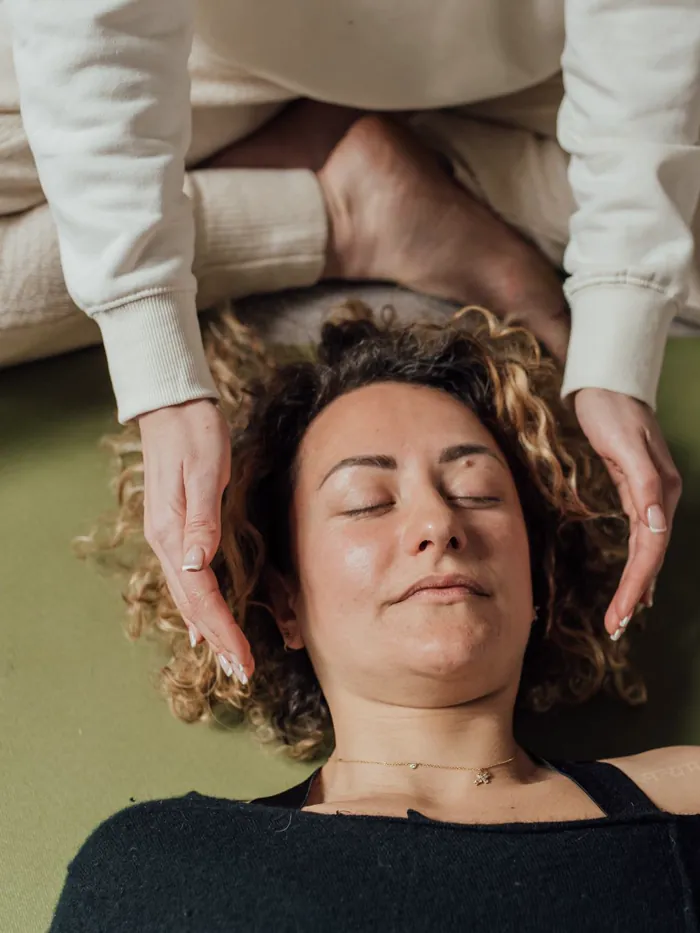
Far more people feel an aura than see one. They notice warmth, tingling or a gentle pressure when their hands approach someone's body, or a sense of someone's mood before a word is spoken. In psychic language this is close to clairsentience, or clear feeling, and it tends to sharpen with gentle, regular practice.
Knowing
Some people simply get an impression of a person's energy: heavy, bright, scattered or calm. It's less a picture and more a felt understanding.
Most people who explore this find they lean towards one of these three ways, and that it shifts depending on how rested and relaxed they are. You may also notice you sense some people far more strongly than others. That's common, and it's one reason practitioners stress consent and kindness: noticing someone's energy is a privilege, not a licence to comment on it uninvited.
A gentle safety note. If you start seeing halos, flashes or coloured rings around lights or people with your physical eyes, especially suddenly, please see an optician or your GP. These can be signs of migraine aura or eye problems, and new flashes with a shower of floaters need urgent attention.
Aura photography: what it actually shows
Aura photos are popular at wellbeing fairs, and they can be fun. It helps to know what they are. Older "Kirlian" photography captures a real electrical glow, known as corona discharge, around objects placed on a charged plate. Researchers in the 1970s showed that most of the variation in these images comes from moisture on the skin, so it isn't evidence of a spiritual aura.
Most modern aura cameras work differently. They usually take readings from sensors you rest your hands on and then use software to add colours to a photograph. The colours are generated by the device's programming, not captured from light around your body. Enjoy the picture if you like, but don't treat it as a reading of your soul or health.
The same goes for apps that claim to read your aura from a selfie. They can be a playful prompt for reflection, and that's all. If you want a genuine conversation about how your energy feels, a human being who listens will always tell you more than a camera.
Energy awareness in my readings
When I read for someone, I work with psychic insight and oracle cards, and energy awareness sits alongside both. I'm not looking for a rainbow around your head. It's more that I notice the quality of your energy: whether it feels tight and guarded, heavy and tired, or open and ready for change. Those impressions help me understand where you are and what support might help.
Because energy is said to shift so readily, I see it as a snapshot, not a verdict. If you're interested in work that focuses on rebalancing rather than reading, my spiritual healing sessions in London offer a calm space for that. Please think of healing as an addition to conventional treatment: it does not replace anything your GP or specialist recommends, and guidance of any kind is not a substitute for medical, psychological, legal or financial advice.
I loved Michelle's warmth and empathy and it was clear very quickly that she was accurately reading my energy.
Diane Cox
A simple aura sensing exercise
This exercise focuses on feeling, which most beginners find easier than seeing. Take about ten minutes.
- Settle. Find a comfortable seat, take a few unhurried breaths and soften your jaw.
- Warm your hands. Rub your palms together briskly for twenty seconds.
- Find the edge. Hold your palms facing each other about thirty centimetres apart. Slowly bring them closer, then apart again. Notice any warmth, tingling, springiness or resistance.
- Try with a partner. With their permission, slowly move one hand towards a friend's shoulder from about an arm's length away. Stop when you notice any change and see how far from the body it is.
- Swap and compare. Let your partner try with you. Talk about what you each felt, without judging it.
- Close. Shake out your hands, wash them in cool water if you like, and have a drink.
If you'd like to try seeing, ask a friend to stand against a plain white wall in soft light. Gaze softly at the space around their head and shoulders rather than at them, and note what you notice. Keep a short record either way. Over time you'll learn what's consistent for you, and what was simply tired eyes. If this sparks a wider interest in sensing energy, my guide on developing your intuitive abilities has further practice ideas.
Sources
- Aura: etymology, origin and meaning, Online Etymology Dictionary. Accessed 4 November 2026.
- Helena Blavatsky, Encyclopaedia Britannica. Accessed 4 November 2026.
- Man Visible and Invisible (C. W. Leadbeater, 1902): the health aura and etheric double, Heidelberg University Library digital collections. Accessed 4 November 2026.
- Image modulation in corona discharge photography (Pehek, Kyler and Faust, 1976), Science via PubMed. Accessed 4 November 2026.
- Symptoms: migraine, NHS. Accessed 4 November 2026.
- Floaters and flashes in the eyes, NHS. Accessed 4 November 2026.
Spiritual traditions are described as traditions, and research is linked where it exists. Guidance here is not a substitute for medical, psychological, legal or financial advice. How these guides are written and checked.
- What Is Spiritual Healing? Meaning, Forms and EvidenceThe meaning of spiritual healing explained honestly: where it comes from, the main forms, what happens in a session, what research does and doesn't show, and how to choose a healer.
- What Is Reiki? Origins, Sessions and Honest EvidenceReiki is a gentle Japanese practice using light touch or hands held just above the body. Here is how it began, what a session is like, and what research does and doesn't show.
- The Difference Between a Psychic and a MediumEvery medium is psychic, but not every psychic is a medium. Here is what that means in practice, how each kind of reading feels, and how to choose the right one for you.